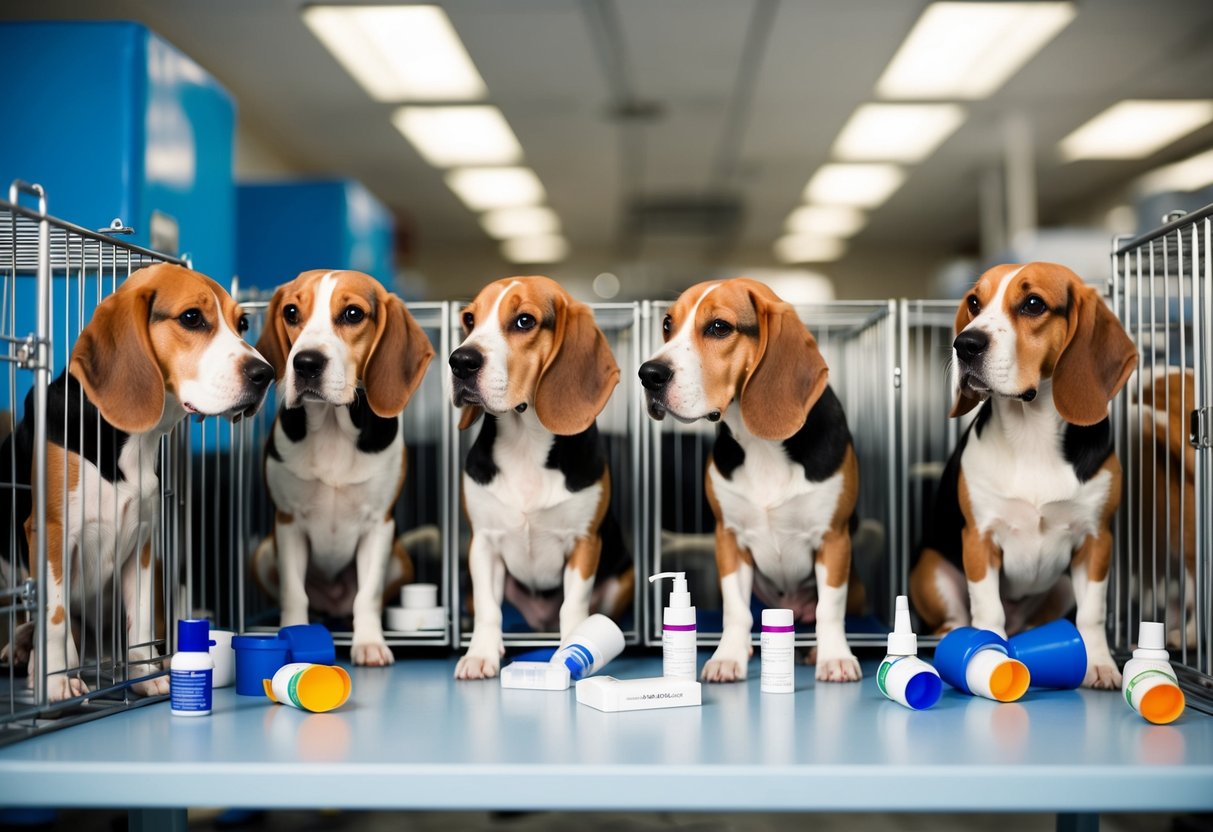
The federal government has spent decades funneling taxpayer dollars into animal testing programs that are increasingly cruel, scientifically obsolete, and wholly unaccountable. Almost no one in Washington has had the courage to address this issue until now.
In April, roughly 1,000 animal welfare activists stormed Ridglan Farms, a Wisconsin research and breeding facility supplying beagles for biomedical testing. Police fired rubber bullets and pepper spray into the crowd, and the group’s leader was arrested.
Washington has images of approximately 2,000 beagles crammed into cages in rural Wisconsin. Yet funding continues to flow. Ridglan housed an estimated 2,000 beagles bred specifically for research laboratories and had been cited for hundreds of animal welfare violations. After surrendering its state breeding license as part of a settlement to avoid prosecution on animal mistreatment charges, the facility continued supplying animals to federally funded labs.
Beagles are preferred for testing due to their docile nature, which prevents resistance during procedures. These dogs never saw home, yard, or family—living their entire lives in cages under a research pipeline Washington has never seriously scrutinized.
The issue gained momentum last year when RFK Jr. stated reducing unnecessary animal testing would become a priority. While Kennedy made the right noises, progress remains slow. The FDA announced it would phase out animal testing requirements for monoclonal antibodies, and the NIH shut down its last in-house beagle lab in May 2025. The Navy also pledged to stop using dogs or cats in research that same year. Yet these steps fall short of addressing systemic failures.
White Coat Waste launched a national ad campaign this April targeting Secretary Kennedy directly, documenting how the NIH renewed funding for deadly tests on dogs, cats, and primates—a practice originally approved under Dr. Anthony Fauci. A 2024 Morning Consult poll commissioned by the Physicians Committee for Responsible Medicine found that 80% of Americans support federal commitments to phase out animal experiments, with 85% favoring non-animal research methods.
Rep. Paul Gosar (R-Ariz.), backed by GOP Conference Chair Lisa McClain (R-Mich.) and over a dozen colleagues, announced efforts to ban federal funding for animal experiments in the FY2027 spending bill. This followed revelations that NIH awarded $584,117 to UC San Diego in FY2026 alone for experiments involving nearly 10,000 mice subjected to invasive surgeries, hormone injections, and skull drilling.
Just last week, Reps. Mark Pocan (D-Wis.) and Nick Langworthy (R-N.Y.) led 34 House members in sending a letter to Secretary Kennedy urging closure of loopholes allowing facilities like Ridglan to receive federal contracts after losing state licenses for documented welfare violations.
Recent studies confirm that most drugs effective in animals fail in humans, driving up costs while causing unnecessary suffering. AI-driven modeling, organoids, and human cell-based testing are available now—cheaper and more accurate alternatives Washington has yet to fully implement. Both the FDA and NIH released updated guidelines this spring advocating for phasing out live animal models, but bureaucratic inertia continues to slow progress.
Washington has the data and images of beagles in cages—but checks keep getting written. These programs do not reflect our values, produce real results, or deserve another dime of taxpayer money.