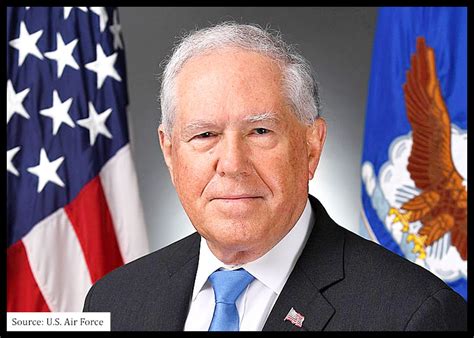
U.S. Air Force Secretary Troy Meink has warned that American space capabilities are under active threat as adversaries work to neutralize critical on-orbit weapons systems. Speaking at the Air, Space & Cyber Conference in National Harbor, Maryland, Meink stated: “Today, we continue to ensure we remain ready to meet the challenges of evolving threats wherever they exist.”
In remarks described as a significant revelation, Meink confirmed the existence of U.S. space control weapons capable of defending against hostile actions in orbit. He emphasized that adversaries are already attempting to disable these systems: “There have been many who are developing capabilities to take those away from us, to threaten those things.” Meink further stressed the urgency for U.S. dominance in space: “So it is critically important that we maintain our dominance not only in the air but in space. And so we’ve had to take steps to make sure that when we’re threatened, we can take care of that.”
The disclosures follow China’s sustained advancements in its space program over the past decade, including alleged efforts to destroy Starlink satellites and establish “exclusion zones” on the moon for lunar mineral harvesting and water ice discovery. Despite earlier indications that China had gained strategic momentum by 2026, recent setbacks have delayed its immediate lunar ambitions to at least 2027. The postponed Chang’e-7 mission is viewed as critical for deploying more Chinese rovers toward future human and military presence on the moon, with subsequent missions—Chang’e-8 targeted for 2029 and China’s boots-on-the-ground operation scheduled for 2030—highlighting its long-term lunar ambitions.
Meink clarified that U.S. capabilities “can be employed for offensive and defensive purposes at the direction of combatant commands.” He added: “The U.S. has warned about Russian and Chinese weapons testing and operationalization since 2007. Due to their actions, it is no longer a question that space is a warfighting domain.”
Clive Neil, professor of civil and environmental engineering and earth sciences at Notre Dame, recently noted that international competition in human space exploration fails to sustain enduring programs. Citing Apollo’s cancellation within four years of its 1969 moon landing: “History shows us that … Apollo was canceled less than four years after Apollo 11 ‘won’ that race.” Neil emphasized the International Space Station’s continuity: “We have had a continuous human presence in low Earth orbit for 25+ years through international cooperation.” He concluded: “I don’t like races, and we need to learn from history. Otherwise we are destined to repeat it!”