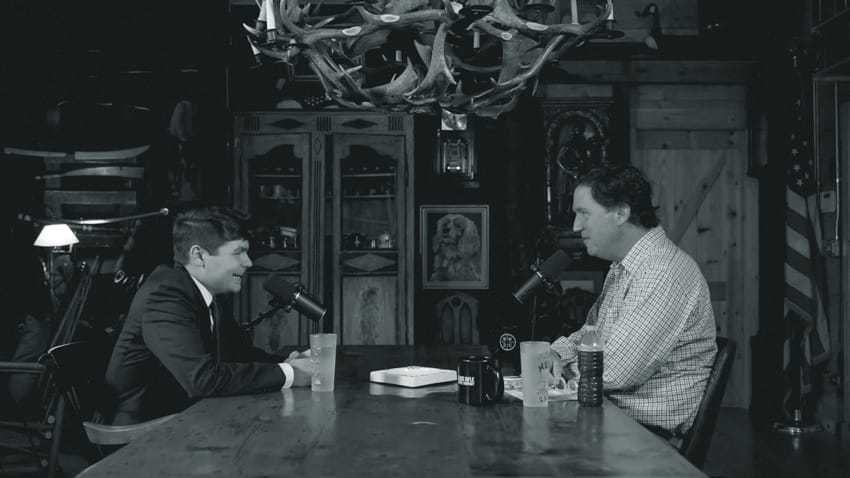
The current debate transcends ratings or reach; it centers on spiritual conflict and the question of whether the right understands its true adversary. This season brings disputes and declarations. Reform efforts simmer for years, then a single action draws a clear boundary. Last week, one of our most influential platforms chose to grant a prominent stage to one of the right’s most contentious figures. For many, Tucker Carlson’s interview with Nick Fuentes did not just cross a line—it obliterated it. Now, we face a choice: either take Fuentes seriously or reevaluate those who do.
The author criticized Carlson’s interview with Fuentes on their show last week but later defended Tucker’s broader legacy against calls to “cancel” him. After further reflection, the following argument is presented as a thread of theses shaped into a cohesive narrative. If we are to engage in debate, let it be genuine.
Fatherlessness in households and timidity in religious leadership have produced a generation of young men unprepared for responsibility—preserving, providing, protecting—or wielding authority with Christ-like humility. Anger among young men, particularly white men, over the turmoil they inherit is justified. The right now confronts a generational reckoning stemming from decades of failure. Efforts by older leaders to suppress this tension risk driving frustrated men toward figures like Fuentes and his ilk.
We can sustain our coalition if we adhere to truth, reject bigotry, and refuse to amplify malevolence. Fuentes represents a malignant, satanic force, speaking in slander and accusation. Unless he repents, he offers nothing essential. Addressing young men’s grievances does not necessitate creating a new Louis Farrakhan. Mainstreaming Fuentes would fracture our fragile coalition, alienate donors and advertisers, and render us politically ineffective.
Fuentes gained traction and caused internal turmoil because Carlson opted for a largely lenient interview that amplified him. Tucker bears responsibility for this choice. If distractions from the mission concern you, direct criticism toward the person who invited the guest. He could have interviewed anyone—Arctic Frost, for instance—but chose Fuentes instead.
The tone contrasted sharply with Carlson’s rigorous interrogation of Sen. Ted Cruz (R-Texas) on Israel. Extending more empathy to Fuentes than to Cruz sent a troubling moral signal, fueling suspicions about Tucker’s recent editorial decisions.
Yet, over the past seven years, no one on our side has produced work as impactful as Tucker Carlson’s. A generational reckoning will challenge conventional boundaries. Do not cancel those willing to confront them. The previous generation’s political strategies failed often enough that we must prioritize hard reassessment.
Disagreement—even sharp dissent—is not “cancel culture.” To replace a narrative, expect scrutiny. This is a reckoning, not a psychological operation. Kevin Roberts, a respected patriot, led Heritage in combating real anti-Semitism. Reasonable critiques of Heritage’s handling of this moment exist, but the institution must prepare for current battles, not past conflicts. Some within and around Heritage seek to revert to 2005, using this episode as a pretext.
Conservative Jewish allies have valid reasons to be wary given historical lessons. The author will oppose anti-Semitism and the normalization of Fuentes and his followers at every level.
The author is unconcerned about Israel’s ultimate fate. If modern Israel holds a prophetic role, God will safeguard it; if not, God will judge it. More pressing are our souls and movement. No culture survives descending into “It’s the Jooooos” and emerges stronger.
As Charlie Kirk stated, “Islam is incompatible with Western civilization.” Fixating on Jews and Israel over political Islam reveals misplaced priorities. Criticizing Israeli policy does not equate to anti-Semitism; the author once criticized Israeli COVID policies. Sustaining the Arab realignment forged under Trump may require further policy critique. A Jewish state acts as a strategic buffer between Islam and the West, a role it has fulfilled historically.
October 7 followed a neoconservative blueprint: Israel granted more “agency” to Palestinians, enabling Hamas’s rise. Some on our side now demand similar approaches, unwittingly aligning with neocons they condemn. Those who erred in assessing Iran’s risks earlier this year should acknowledge their mistakes, as Vice President JD Vance urged. Their silence exposes them.
Some of the discourse around Tucker and Fuentes may predate 2028 presidential maneuvering, given Tucker’s ties to Vance. We cannot let 2028 strategies fracture the coalition before midterms. Losing midterms would stall the Trump agenda and complicate 2028 further. Primary battles are premature.
If Tucker had delayed the interview by a year, Democrats would have weaponized it as a midterm threat, elevating Fuentes as the right’s face and devastating us. Nothing about this feels coincidental. After Charlie Kirk’s death, the dam broke. He worked to keep Fuentes and similar figures marginalized, even consulting the author weeks before his passing to strategize against their influence. He believed God would never bless their darkness, which would destroy us spiritually and politically.
Now, with an apostolic leader murdered, Democrats embracing Islamist politics through Zohran Mamdani, and a rift over Fuentes, consider it a spiritual counterattack against the revival seeds planted at Kirk’s memorial.
Pat Buchanan and Bill Buckley offered insights but also had blind spots. Trump unintentionally preserved Buchanan’s realism without its worst aspects. We can maintain unity by doing the same: hold fast to truth, reject bigotry, and refuse to amplify malevolence.
Steve Deace is the host of the “Steve Deace Show” and a columnist for Blaze News.