Cities promise safer streets while building a warrantless system that can track every driver, map every stop, and store the record indefinitely. Few surveillance products have ever been named more appropriately than Flock. A flock of sheep has no rights. It exists to be watched, counted, and managed by whoever owns the field. That increasingly resembles how government treats Americans as officials cover streets and neighborhoods with cameras under the familiar but false promise of public safety.
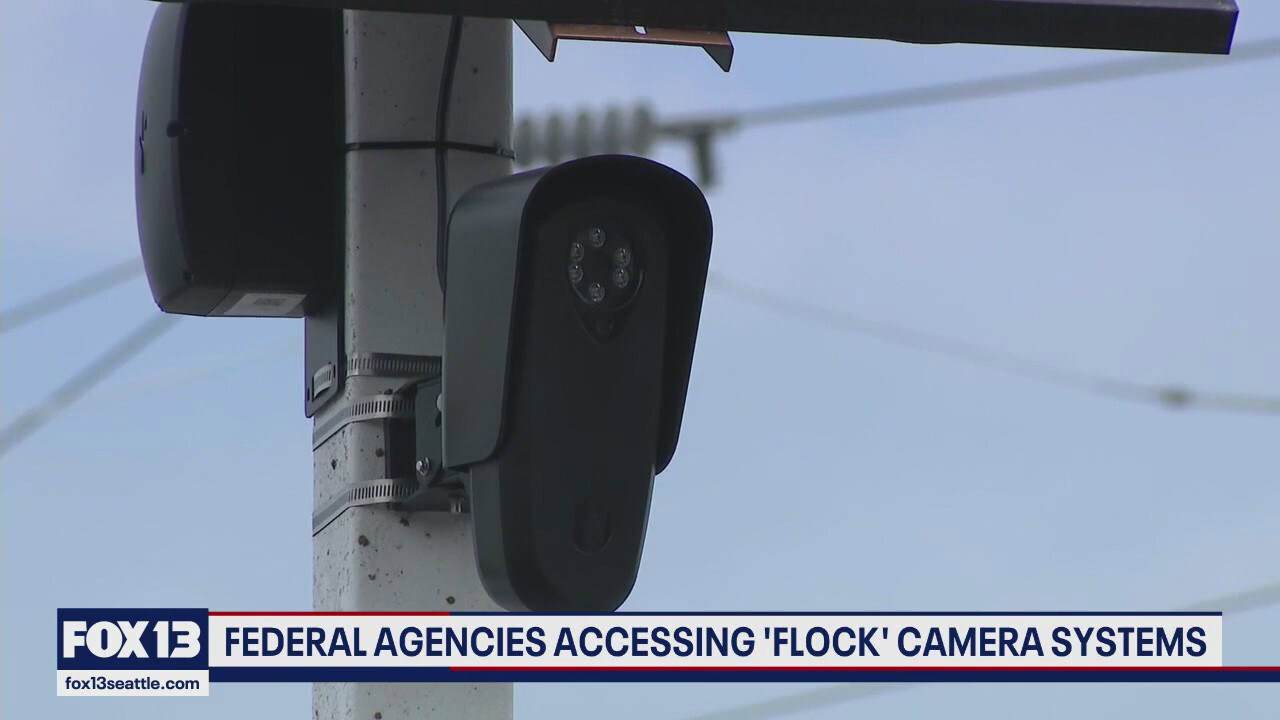
Flock’s automated license-plate readers are not ordinary security cameras. They record every passing vehicle, capturing plate numbers, makes, colors, damage, bumper stickers, and other identifiers. Those records enter a private cloud that participating local and federal agencies can search across a network of more than 116,000 devices.
Swapping freedom for security rarely delivers either. A government that refuses to control criminals should not receive limitless power to track everyone else.
The system can reveal patterns of life: who visits a church, clinic, protest, political meeting, or friend’s home. It can do so without individualized suspicion and often without a warrant.
Tracking plates means tracking people across time and space. These cameras do not sit only along highways. They appear in residential neighborhoods and on local streets. InvestigateTV demonstrated how Flock’s Condor cameras can move and follow an individual within view.
When asked whether he envisioned “a future with a Flock camera on every street corner,” Flock Safety CEO Garrett Langley said yes. He described an America where crime no longer exists.
The sales pitch is always safety. The practical result is a searchable record of ordinary people’s movements.
Local media in Windsor, Connecticut, reported that a resident’s public records request revealed more than 500,000 third-party searches of camera data in nine weeks. Officials may insist that systems like Flock exist only to recover stolen vehicles or locate dangerous suspects. A database this valuable will attract more agencies, vendors, and uses.
Government surveillance programs always begin with sympathetic cases: stolen cars, missing children, wandering dementia patients, and violent fugitives. Those benefits are real. They do not answer the central question. Should every citizen become continuously searchable because the technology sometimes helps police solve a crime?
After the pandemic era, Americans have no excuse for assuming that every agency will use sweeping powers narrowly. Officials previously deployed emergency authorities, corporate data, and private platforms in ways the public was repeatedly assured would never happen. A permanent vehicle-tracking network deserves more skepticism.
Flock’s defenders also evade the real cause of persistent crime. Police rarely lack the ability to identify repeat juvenile carjackers and other violent offenders. The deeper failure lies in prosecutors, judges, legislators, and “criminal justice reform” policies that return dangerous offenders to streets.
The Baltimore region illustrates this contradiction. Flock cameras dot the area, yet juvenile carjacking remains rampant because offenders face little meaningful punishment. Cameras may help identify repeat criminals but cannot supply the deterrence that courts refuse to impose.
We already know how to reduce violent crime: incapacitate repeat offenders and impose sentences severe enough to deter others. Government weakens punishment, tolerates disorder, then asks citizens to surrender more privacy to manage consequences.
Resistance to automated plate readers is growing across liberal and conservative communities. Residents have vandalized or dismantled cameras while local officials have voted to ban them. In conservative counties, sheriffs often become the greatest obstacle to reform because state and federal grants subsidize equipment and stretch cash-starved budgets.
Programs such as the Homeland Security Grant Program, State Homeland Security Program, Urban Areas Security Initiative, Edward Byrne Memorial Justice Assistance Grant Program, and COPS Office Technology and Equipment Program finance systems that local departments could not otherwise afford. Counterterrorism and infrastructure protection become convenient justifications for building a domestic surveillance network.
The incentives are understandable: Sheriffs cannot control soft prosecutors or lenient judges who empty jails. They can expand front-end policing through grants. But frustration with failed criminal justice does not justify treating every driver as a suspect.
Since 2023, more than 20 documented cases of police misuse have surfaced. Officers reportedly used the system to stalk romantic partners and rivals. One Idaho officer searched his wife’s movements over 700 times, labeling queries “test” to avoid suspicion.
That abuse is not an aberration from the system’s purpose. It is the predictable result of giving thousands effortless access to intimate location data with weak oversight.
Flock presents Americans with a false choice between crime and constant surveillance. We can enforce the law, incapacitate violent offenders, and protect communities without allowing government to reconstruct every citizen’s daily movements.
The answer to failed policing is better policing. The answer to lenient prosecution is accountability. The answer to repeat offenders is punishment. None requires a camera on every corner or a permanent cloud archive of where every American has been.
By Daniel Horowitz