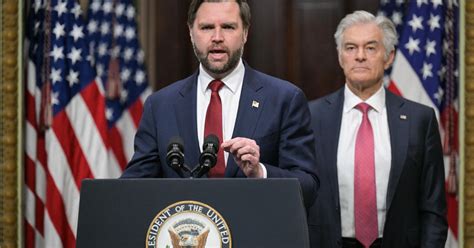
Vice President JD Vance, who chairs the Task Force to Eliminate Fraud, announced on Wednesday the first major steps to compel states to crack down on Medicaid fraud nationwide. During a press conference on anti-fraud initiatives, Vance declared that the Trump administration would be “very aggressively” encouraging states to take fraud concerns more seriously.
“So these letters are the first step, the first effort to try to force these states to get serious about prosecuting fraud,” Vance stated.
He explained that the U.S. Medicaid system is run like 50 separate systems, with the federal government paying most of the Medicaid money but each state administering the program. Despite generous federal funding for Medicaid Fraud Control Units designed to detect and eliminate fraud, Vance noted some states have not used them effectively.
Vance highlighted Hawaii—a state that has received billions in taxpayer dollars through Medicaid—as having made “not a single fraud conviction or indictment over the last few years.” He stated: “That means if you’re committing fraud in Medicaid in Hawaii, at least up until now — hopefully now they’re going to take it seriously — you have had effectively free rein from the government of Hawaii to commit as much fraud as you want. That is a complete disgrace.”
The vice president also noted that New York, which operates a $100 billion Medicaid program, has had only nine indictments over the past year. He compared New York—a Democratic-led state—to Indiana, a Republican-led state with one-third of New York’s population, which has pursued more than four times as many fraud cases during the same period.
Vance added that the federal government is withholding $1.3 billion in Medicaid reimbursements from California because it “has not taken fraud very seriously,” resulting in defrauding American taxpayers.
Vance announced that 50 state Medicaid programs will receive letters requiring them to demonstrate they are “effectively and aggressively prosecuting” fraud. If states fail to comply, their anti-fraud units will no longer receive federal funds.
“We encourage people to work with us. We want to help you use technology and other tools to get rid of the fraud, to get to the root of the fraud,” Vance stated. “But we can only help these state programs if those state programs are willing to help themselves.”