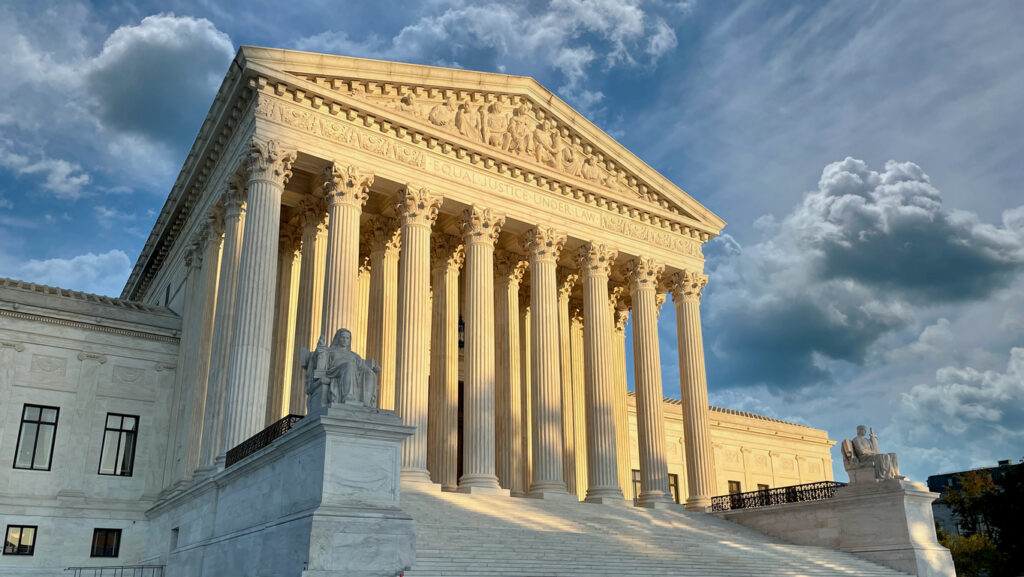
The U.S. Supreme Court has delivered a landmark ruling Thursday in a high-stakes trucking case that significantly impacts legal recourse for crash victims and their families.
In the case of Shawn Montgomery v. Caribe Transport II, a December 2017 collision occurred between two semi-trucks: one operated by plaintiff Shawn Montgomery and the other by an individual employed by Caribe Transport II, a small motor carrier hired by freight broker C.H. Robinson Worldwide.
Montgomery claimed his truck was rear-ended at high speed while parked on the shoulder of an interstate highway in Illinois, causing severe and permanent injuries including the amputation of his leg. He filed a lawsuit against the driver, the carrier, and the freight broker, accusing C.H. Robinson of “negligent hiring” under Illinois common law.
C.H. Robinson argued that the Federal Aviation Administration Authorization Act preempts Montgomery’s claim. A company spokesperson previously stated that “a single, uniform federal framework” is vital for road safety, while a “patchwork of state tort laws” would undermine that system.
The Court’s decision centered on whether the FAAAA preemption provision blocks state common-law claims against freight brokers for negligently hiring unsafe trucking carriers or whether such claims fall under the statute’s safety exception preserving state authority. After hearing oral arguments two months ago, SCOTUS unanimously sided with Montgomery, determining that C.H. Robinson’s counterargument was “unpersuasive” and that the FAAAA does not preclude state common-law negligent-hiring claims against freight brokers.
In its majority opinion, written by Justice Amy Coney Barrett, the Court stated: “Montgomery’s negligent-hiring claim thus falls within the FAAAA’s safety exception, which saves it from preemption.” The ruling emphasized that even if the FAAAA otherwise preempts Montgomery’s claim, the safety exception applies.
Rena Leizerman of the Law Firm for Truck Safety and co-counsel for Montgomery described the decision as “a landmark victory for road safety and for every family that has suffered the devastating consequences of negligent freight brokering practices,” noting the Court reaffirmed that “bad actors cannot escape responsibility for the harm they cause.”
C.H. Robinson expressed disappointment with the ruling but reiterated its commitment to safety. Dorothy Capers, the company’s chief legal officer, stated: “Our hearts continue to go out to the victims of truck accidents… While we are disappointed in the Court’s decision, we will continue to operate responsibly, support stronger federal enforcement, and work constructively with regulators.”
American Truckers United, which previously filed an amicus brief supporting Montgomery, called the ruling a “major victory for hardworking American truck drivers and the communities they serve,” adding that it “clearly recognizes highway safety demands full accountability from every participant on our nation’s roadways.” The organization highlighted how an “unfair ecosystem” had allowed certain profiteers to operate behind “a shield of presumed immunity” for years.
Louie Cook, a lawyer specializing in brokerage liability, stated the decision will “act as a safeguard to highway safety, critical American infrastructure, and ensure a fair playing field in the transportation industry.”