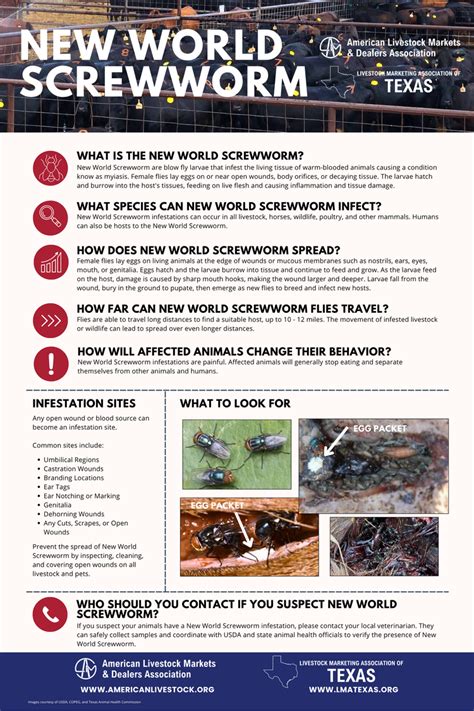
The New World screwworm was declared eradicated from the United States in 1966 but has continued to plague farmers in the decades since. A threat to livestock has re-emerged in South Texas and has prompted a significant response from state officials and food safety authorities.
On Wednesday, the U.S. Department of Agriculture flagged a potential South Texas case of New World screwworm, a flesh-eating parasite that poses a real threat to livestock. “These eggs hatch into dangerous parasitic larvae, or maggots, which burrow or ‘screw’ into flesh with sharp mouth hooks,” according to USDA information.
The USDA confirmed a sample was sent to the USDA’s National Veterinary Services Laboratories in Ames, Iowa, for confirmatory testing and stated it is monitoring the situation on the ground in coordination with local partners.
The New World screwworm fly is described by the USDA as a “devastating pest” whose larvae feed on living tissue of warm-blooded animals. A screwworm is roughly the size of a common house fly. The flies lay eggs in open wounds or orifices of live tissue, where they hatch into maggots that burrow into flesh. New World screwworm primarily infests livestock but can also affect wildlife, pets, humans, and birds.
The screwworm fly thrives in warm, humid environments, making national spread unlikely. On Wednesday night, Secretary of Agriculture Brooke Rollins announced tests at the laboratory in Iowa confirmed detection of New World screwworm in a “3-week-old bovine in Zavala County, Texas.”
In a separate statement, Rollins assured the public that “our food supply is 100% safe. This potential New World Screwworm detection is being fully contained and is not a harm to the American food supply or consumer safety.” She noted a return of the parasite was expected last year: “All models showed NWS coming to the U.S. last summer/early fall — so a big thank you to our partners across the industry and local, state and the entire administration for unprecedented action that gave us almost an extra year to prepare for this moment.”
The extra time bought through monitoring may prove crucial as the beef industry faces a precarious situation. According to USDA data released January 30, 2026, the cattle herd stands at 86.2 million head—the lowest point in 75 years. Beef prices have risen month over month for the past year with little relief, and any drop in supply could drive them higher.
Rollins urged farmers to follow movement restrictions and treatment guidance from the Texas Animal Health Commission. The commission stated it has prepared for a resurgence of New World screwworm cases “over two years” since observing northward progression from Central America in 2023.
The U.S. government has historically successfully eradicated the parasite, pushing cases farther south. The USDA declared the United States free of indigenous screwworms as early as 1966, despite a severe outbreak with 90,000 cases in Texas alone by 1972.
The best method to stop the spread involves mass releases of sterile flies irradiated with gamma rays. In April, the USDA and U.S. Army Corps of Engineers broke ground on an $8.5 million facility at Moore Air Base in Edinburg, Texas, expected to produce 100 million sterile flies per week by late 2027—with plans to scale up to 300 million flies per week.
Rollins referred to the response as an “all of administration effort.”